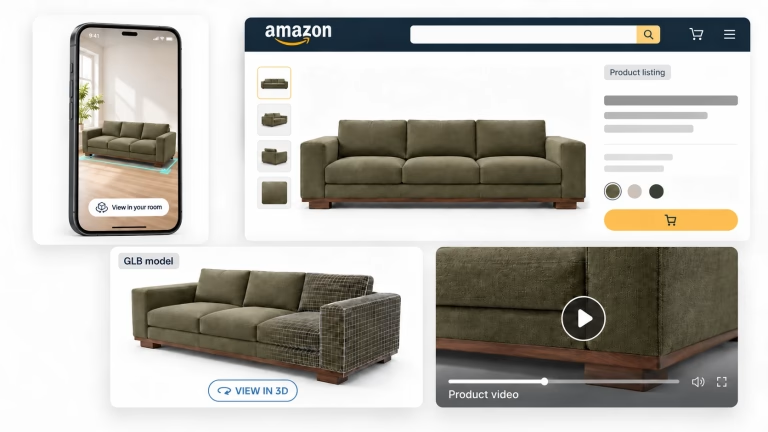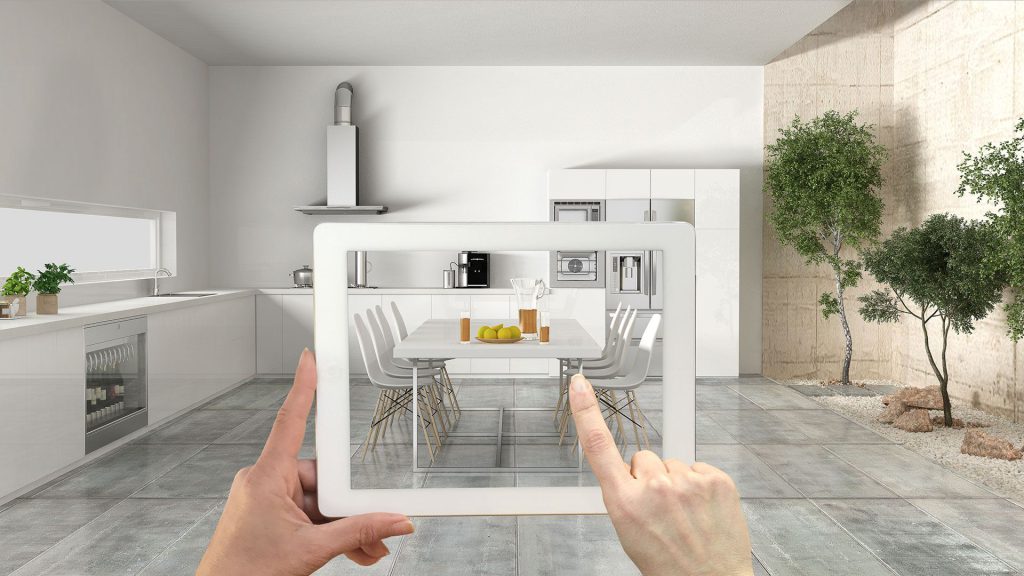
As online shopping continues to grow, manufacturers and marketers are constantly looking for new ways to boost their sales on ecommerce platforms and stand out from the competition. For instance, advanced brands recreate offline shopping experience with AR in ecommerce.
A retail giant IKEA has been successfully using their augmented reality app IKEA Place for over 10 years. But according to research, 52% of sellers feel unprepared to adopt AR. Many doubt whether AR solutions are worth investing in. Of course, AR provides consumers with fun and engaging experiences but how can ecommerce entrepreneurs profit from it?
As an AR 3D modeling services studio, we create 3D objects for any kind of AR tool and also monitor our clients’ strategies. Therefore, we know at least 5 ways you can improve your business with our AR content creation service for ecommerce.

Download CGIFURNITURE price guide and learn the costs of top-tier 3D visualization projects of different scales!
See our pricingBut, for starters, what is AR? And how different is it from VR?
AR stands for Augmented Reality and it allows customers to place virtual products in the real context using digital gadgets. In turn, VR technology doesn’t work with real spaces, it’s all about navigating a virtual environment. Therefore, you can’t use VR without special VR glasses or hand controllers. In turn, AR apps work on any smartphone or tablet.
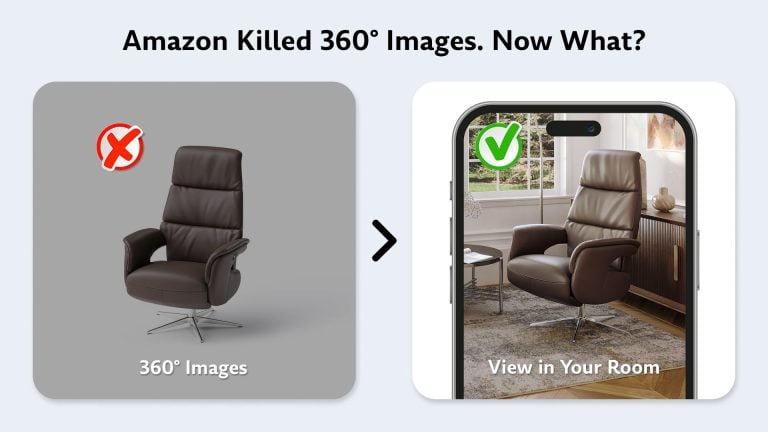
There are different types of augmented reality tools but let’s focus on superimposition-based AR since it’s the best solution for the furniture business. Such apps substitute the original view by adding digital objects on top of it – for example, that’s how the IKEA Place app works.
1. AR Showcases Product Design in Real Environment
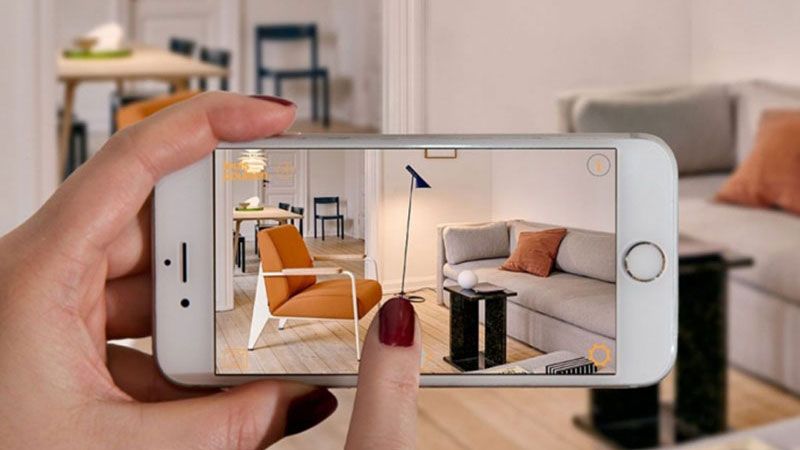
Using AR 3D modeling services for ecommerce, manufacturers provide customers with a fascinating option of adding virtual furniture models into the real environment. Users simply scan their room with a smartphone or tablet camera and select furniture from an online catalog. After the item appears on a screen, they can move and rotate it until the piece takes its place.
Also, AR applications allow users to test all color and style options of a product and examine it in 360° view. This way they can both appreciate all the advantages of design and experiment with furniture virtual placement. Our overview of AR furniture shows how brands across the industry use these previews.

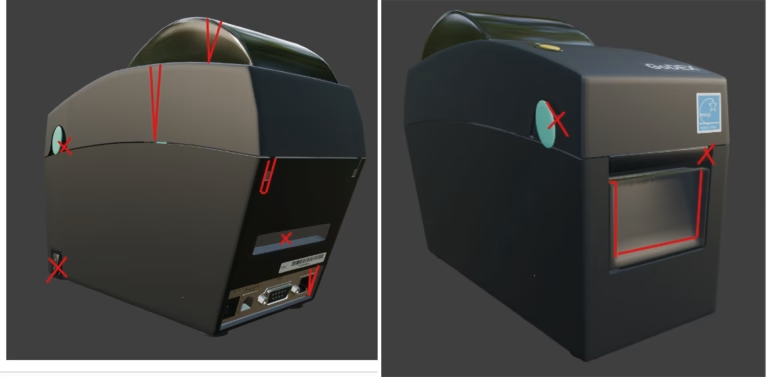
For first-class AR solutions for ecommerce visuals, manufacturers need to order photorealistic 3D models from a CG studio. To achieve realism, CG artists accurately recreate the geometry of a product in 3D and use only custom-made texture maps. Professionally built 3D models for AR keep that realism while staying light enough for phones.
To take the effect further, consider getting product feature rendering services. Images illustrating the features of your offer will increase consumers’ confidence that they are buying a high-quality product that will meet their needs better than anything your competitors offer.
2. AR for Ecommerce Reduces Goods Returns

According to the Global study of online returns, the top reasons why buyers return goods from Amazon (34%) and other ecommerce platforms (46%) are the wrong size, fit, or color. Obviously, this happens because consumers don’t have a chance to try on the products before purchase.
Using AR for the furniture business effectively solves this problem and reduces returns by up to 40%. AR apps are designed to correctly calculate the parameters of the room before users put any 3D models in it. Thus, if a digital object can’t fit the space or is too bulky, it will become obvious in an instant.
Same with colors. If the color schemes of an object and interior don’t work well together, a buyer will immediately see it on the screen and select a different shade. After exploring product features in the AR app, customers will be able to make a purchase decision consciously and most probably won’t return the item.
3. AR Helps Effectively Sell Products via Social Media
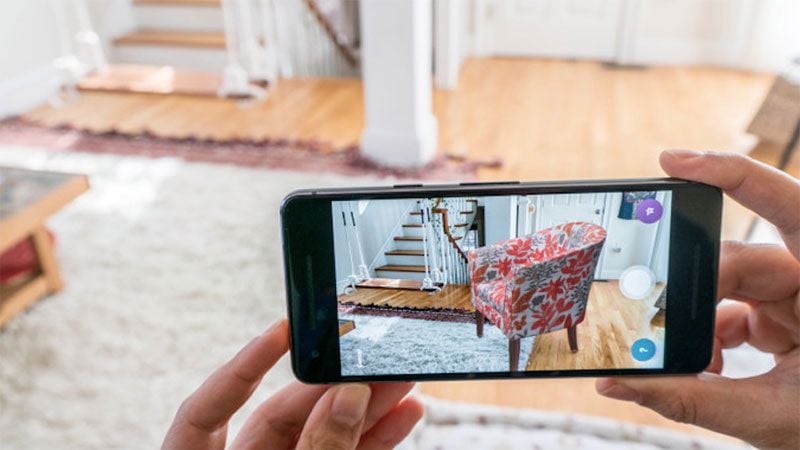
You’ve probably already tried various AR filters on Snapchat or Instagram stories. Those are not just fun for users but also effective for ecommerce entrepreneurs. Many manufacturers and retailers use social media filters to boost awareness of a product and brand, increase audience engagement and outshine their competitors.
For that, furniture brands can provide customers with AR filters that allow adding pieces from the new collection to the room and encourage them to share their opinion on design. And since consumers like playing with filters and showing their results, it will expand the follower base and increase direct sales on social media.
However, not all 3D furniture models work for AR filters. Those should be lightweight objects that are specifically optimized for AR applications. If you have ready-made 3D models of your furniture, you better check with CG artists whether they are compatible with AR apps or not. The latter, in turn, can either optimize your 3D model or create a new one from scratch in the required format. Our guide to how artists create AR 3D models explains that optimization step.
4. AR Increases Your Online Store Conversion
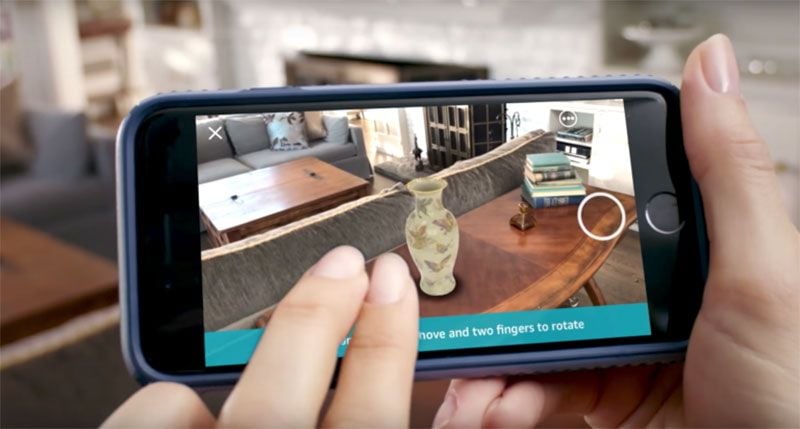
Studies show that 61% of online shoppers prefer augmented reality ecommerce platforms over those without AR. If these numbers aren’t motivational, what is? To integrate AR for ecommerce into your e-store, you can use free or commercial licenses or even develop your own AR application. Several visual merchandising software platforms include AR features you can start with.
Whatever option you choose, an AR tool will definitely improve your conversion . Since customers embrace AR shopping, they will stay longer in your e-store when using the app. With AR, they can take their time and try various designs, explore the whole collection and keep moving virtual objects around the room to find the best position. By prolonging their presence on your ecommerce platform, users boost its conversion – learn how to build the perfect product detail page for ecommerce.
Another way to increase it is to make your AR application easily shareable. In this case, buyers will be promoting your app by sharing their successful furniture arrangements, hence, bringing more new customers to your shop.
5. AR Apps and Tools Boost User Engagement
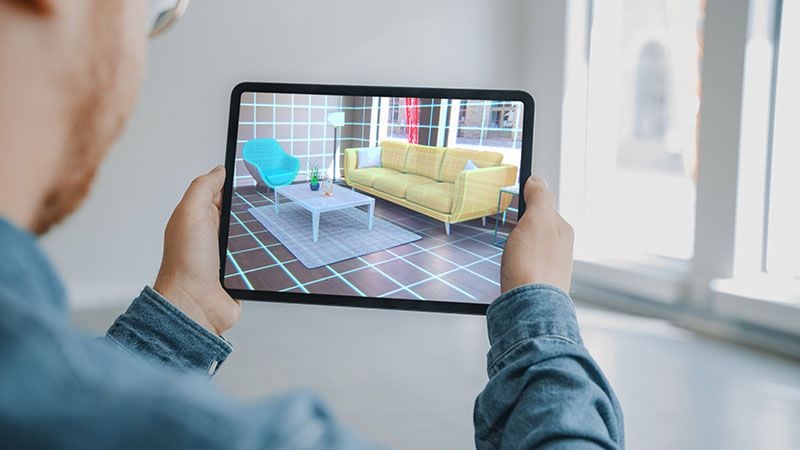
AR-based ecommerce offers a highly immersive experience that makes online shopping an engaging game-like process. Not surprisingly, conversion rates increase by 90% for consumers that engage with AR.
The longer a customer uses your AR app, the more likely they will buy from you. And if not, they at least develop a relationship with a brand and product, thereby, establish an emotional connection and get unforgettable experiences. The next time they need a furniture piece, your e-store will be the first shopping destination on their list.
See our case studies
See our case studiesUsing AR for e-commerce gives manufacturers and retailers a significant advantage over competitors. Firstly, it creates a wow effect and makes shoppers want to try it immediately. Secondly, AR increases consumer awareness of the product and brand. Finally, it boosts your e-store conversion and attracts more new buyers on social media.
Excited to try AR marketing for your business? Order AR 3D modeling services from us and get high-quality 3D models that work for all AR applications!