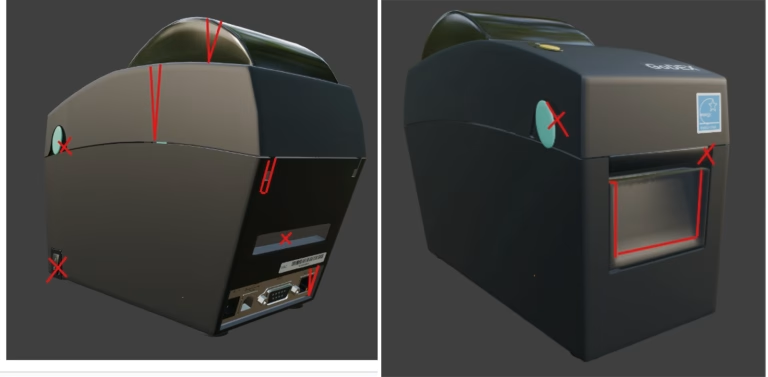
Naturally, when ordering product 3D models from CG artists, manufacturers and marketers expect to get the highest quality 3D objects and scenes. However, often it’s bad texturing with seams and twisted patterns that gives away an amateur 3D modeler. And it’s not about the software itself, it’s mostly how a CG artist uses it.
Product 3D modeling has become a core part of furniture manufacturing and marketing. If you compare product photography vs. 3D rendering, the latter is faster, more flexible and easier to scale. Of course, as demand grows, so do the expectations. Textured models then go into many types of product visualization, from still renders to animation and AR.
CG specialists must have advanced 3D modeling and texturing skills to make top-quality photorealistic models, and those who work in a 3D rendering company can be trusted the most. See it for yourself: a studio provides its employees with all necessary hardware, licensed 3D software, add-ons and other tools. On top of that, 3D companies oblige all artists to take special training and courses. Such studios usually offer a full range of CGI services, from modeling and texturing to final rendering.
So before ordering 3D modeling, ask client managers for a portfolio and make inquiries on what tools they use for 3D texturing services. To keep up with modern 3D technologies, read on our top 10 3D texturing software solutions that professionals rely on in 2026.
1. Autodesk Mudbox
- OS: Windows, macOS, Linux
- Price: about $100/year (Autodesk ends subscription sales on November 7, 2026)
- Free Version: not available
- Free Trial: 30 days
Mudbox is a 3D sculpting and 3D texture painting software by Autodesk. Thanks to Autodesk’s reputation, many CG specialists trust it and make tutorials and courses on its new features for the growing community. However, Autodesk stops selling Mudbox subscriptions on November 7, 2026, so today it is mostly a tool for artists who already have it.
Aside from a user-friendly interface and brush-based workflow that many 3D artists find tactile and intuitive, Mudbox has an advanced retopology tool. It allows creating clean meshes from any imported and scanned data, which reduces the number of polygons and makes 3D texturing smooth and seamless. After retopology is done, CG experts can paint textures directly on a 3D model and bake texturing to keep it visually appealing but easy to render at the same time.
2. Adobe Photoshop
- OS: Windows, macOS
- Price: $22.99/mo, $69.99/mo for the whole package (Creative Cloud Pro)
- Free Version: not available
- Free Trial: 7 days
Photoshop is a legendary photo editing software used by professionals in various industries, and it’s still a standard tool for creating and refining textures and maps. It’s not a full 3D painting tool, but it works great with UV maps, layered textures and custom material details.
Its main strength among programs for texturing 3D models is flexibility. CG artists can create custom textures and maps from scratch, use adjustment layers and filters, and add a wide range of plugins. After the texture is ready, they can save it in a .png file format and export it to another soft. Many artists also start from ready-made 3D textures and refine them here.
Some users don’t like the subscription model. But because Photoshop is so popular, there are various tutorials and courses on it and a strong community of users all over the globe.
3. Blender
- OS: Windows, macOS, Linux, FreeBSD
- Price: free
- Free Version: yes
- Free Trial: not available
Blender is an open-source 3D creation suite that works for almost all the 3D processes possible, from modeling, sculpting, texturing and rendering to 3D product animation services and even video editing. Because it is also free software, it stands out from many other 3D texturing tools and has a strong community around it.
Blender has solid texturing tools, although CGI artists often combine it with Photoshop or specialized texturing software for complex materials. Many CG artists use Blender and report detected bugs so that developers fix them in the next version. In the end, you get a working 3D tool that is truly improving from release to release.
4. ZBrush
- OS: Windows, macOS
- Price: €35.90/mo billed annually, €54/mo month-to-month
- Free Version: not available
- Free Trial: 14 days
ZBrush is one of the 3D modeling and 3D texturing tools CG experts use for creating high-resolution 3D models. It is similar to traditional sculpting and has powerful inner processing. This feature allows you to create complex 3D objects from billions of polygons without buying expensive graphics cards.
Its brushes work a lot like traditional sculpting tools, so ZBrush is great for organic forms and detailed surfaces. CG artists often make a detailed model here and then retopologize and texture it in other software.
The interface takes some time to learn. However, once CG artists get used to it, ZBrush becomes one of their main tools.
5. Adobe Substance Painter
- OS: Windows, macOS, Linux
- Price: $24.99/mo for Substance 3D Texturing (individual subscription), $59.99/mo for the full Collection, $119.99/mo for teams
- Free Version: not available
- Free Trial: 30 days
Substance Painter is one of those tools made for professional 3D texturing services. Unlike Photoshop, it allows users to paint in full 3D with physically based rendering workflows.
Artists can use high-resolution shaders, smart materials and procedural masks here. Another advantage of Substance Painter is that it’s compatible with other Adobe products and works for both organic and hard surface assets. Materials like these are a big part of realistic furniture rendering.
The main limitation is hardware. To run it well, CGI artists need a powerful graphics card or a gaming grade workstation.
6. 3D Coat
- OS: Windows, macOS, Linux
- Price: €379 permanent personal license, €159 for 3DCoatTextura
- Free Version: 3DCoatPrint
- Free Trial: 30 days
3DCoat is 3D sculpting and painting software that combines sculpting, UV mapping, retopology and texture painting in one place. Using it, CG artists are able to create free-form organic and hard surfaced 3D models and do retopology in order to prepare surfaces for smooth texture mapping.
Many artists choose 3DCoat for hand painted textures. It also allows users to make their own physically based rendering materials, which provide high shading quality.
It’s friendly to beginners but still gives professional results, so you can find it both in 3D rendering studios and in independent projects.
7. ArmorPaint
- OS: Windows, Linux, macOS + early access iOS and Android builds
- Price: $19
- Free Version: no
- Free Trial: no
ArmorPaint provides CG artists with the option of painting multiple maps at once. This allows them to create custom textures and materials with complex colors and bump maps, and to preview results instantly using ray traced viewports.
To make 3D painting smooth and fast, ArmorPaint supports GPU acceleration, which means it is running on the graphics processing unit and its resources. Of course, you need modern hardware for a seamless workflow. On top of all that, ArmorPaint has experimental mobile versions. This option allows CG specialists to work outside of the 3D rendering studio and gives them additional creative freedom.
8. Mari
- OS: Windows, macOS, Linux
- Price: $1,289/year (team subscription), $689/year (individual subscription)
- Free Version: Mari Non-commercial
- Free Trial: 30 days
Mari from Foundry is a powerful soft that provides CG specialists with unlimited texture painting. It can handle thousands of textures per one 3D model, which allows creating the most complex objects and characters.
Because of its naturalism and cutting-edge performance, it’s one of the most popular 3D texturing tools used in the movie industry and AAA production, where assets must hold up in close-up shots. Mari is not cheap, but for complex characters and environments it’s often worth the price.
All in all, Mari is a professional 3D tool that experienced CG artists use mostly for large-scale or high-budget projects.
9. SelfCAD
- OS: Windows, macOS, Linux
- Price: $14.99/mo, $11.99/mo (one-year subscription)
- Free Version: yes
- Free Trial: 10 days
SelfCAD is a browser-based and cloud-based 3D texturing tool. It allows CG artists to create 3D models literally from scratch, i.e. from 3D sculpting and texturing to rendering and 3D printing the final object, without installing heavy software.
On top of that, SelfCAD has a huge database of ready-made 3D printable designs and a comprehensive library of objects and parts. This way, CG artists can save time on base modeling and move straight to customization and texturing. As a result, it’s often used for simpler projects like rapid prototyping or education.
It can’t replace high-end studio tools for complex photorealistic objects, but it works well for learning and for tasks with tight deadlines.
10. PaintCube
- OS: Windows, macOS, Linux
- Price: Free
- Free Version: yes
- Free Trial: Beta
PaintCube is another web-based 3D texturing soft that provides CG artists with a convenient and seamless UV workflow. It has all the painting tools to paint textures directly onto the models in 3D space, plus a layering system that allows creating and organizing layers of texture information while painting.
Once the texture is done, it can be easily edited and exported to Photoshop, or used for VFX applications and games. It’s not as advanced as CGI studio tools, but it’s a good option for basic 3D texturing tasks.

Download CGIFURNITURE price guide and learn the costs of top-tier 3D visualization projects of different scales!
See our pricingThese were the 10 most relevant 3D texturing software solutions professionals use in 2026. Surely, they all have their pros and cons, as well as different prices and characteristics. In practice, studios rarely use just one program and combine several tools to get clean geometry and realistic materials.
Now, based on our review, you can determine which 3D tool will work best for your project and ask your CG artists to use it. And remember that quality depends less on the software than on the experience of the people behind it. That is what separates professional 3D modeling services from amateur work.
FAQ
Which 3D texturing tool is best for beginners?
Substance 3D Painter is the best 3D texturing tool for beginners: it’s intuitive, powerful, and widely used in the industry.
What is 3D texturing?
3D texturing is the process of applying a 2D texture to a 3D object. It is based on wrapping a 2D image around a 3D model and creating a certain surface. To create photorealistic texture, CG artists can also add maps, sculpt, paint and shade it as they need before proceeding to render.
How do I choose the right texturing software for my project?
Choose based on:
1) Skill level. Beginners: Substance Painter, 3DCoat. 2) Project type. Games: Substance, Films: Mari, Stylized: 3D Coat. 3) Budget. Free: Blender. 4) Workflow. Match with your modeling/rendering tools.
What’s the average cost of professional 3D texturing software?
The average cost is $20–$50/month or $200–$500/year for tools like Substance 3D Painter or ZBrush. Some offer free versions for students or indie creators.